

From 30 Minutes to 7.5: How the Sublym Transformed Microfluidic Device Fabrication at Emory University
Alessandra Luna, PhD candidate at Emory University & Georgia Tech, shares how the Sublym hot embossing machine replaced unreliable adhesives, delivering permanent bonds, faster prototyping, and batch production for implantable microfluidic sensors.

When you're developing an implantable medical device, every layer of your microfluidic assembly needs to be airtight, durable, and consistent. For Alessandra Luna, a 5th-year PhD candidate at Emory University and Georgia Institute of Technology — the stakes are especially high. Her research focuses on an implantable microfluidic intracranial pressure sensor, a device where fabrication quality directly impacts patient safety and long-term reliability. The Sublym hot embossing machine changed everything.
After struggling with inconsistent adhesive seals for months, Alessandra turned to the Sublym hot embossing machine from Eden Microfluidics. The results speak for themselves: fabrication time dropped from 30 minutes to just 7.5 minutes per cycle, with dramatically improved bond quality. Here's her full story.
The Challenge: Why Double-Sided Adhesive Sealing Falls Short for Microfluidic Devices
Before adopting the Sublym, Alessandra's lab relied on double-sided adhesives to seal the layers of their acrylic (PMMA) microfluidic devices. This is a common approach in academic prototyping, it requires no specialized equipment and is easy to implement. But as Alessandra quickly discovered, it comes with serious drawbacks for any application that demands long-term stability.
Double-sided adhesives are not nearly as long-term stable as the bond produced by embossing. The adhesive seals were inconsistent and unreliable.
— Alessandra Luna, PhD Candidate, Emory UniversityThe adhesive layers would peel off after just several days — a fatal flaw for an implantable sensor that needs to maintain hermetic seals over extended periods. Beyond durability, the manual assembly process was time-consuming and error-prone: each device required laser-cutting the adhesive (30 minutes) followed by hand assembly (3 minutes per device). For a researcher iterating rapidly through prototypes, this bottleneck was unsustainable.
The team knew they needed to shift to thermal bonding, a fabrication method that fuses polymer layers together permanently at elevated temperatures. But traditional hot embossing equipment presented its own obstacles: large footprints, high price tags, and complex operation. What Alessandra needed was something compact, affordable, and ready to use out of the box.
Why the Sublym Hot Embossing Machine?
Three criteria drove Alessandra's decision to choose the Sublym over competing solutions.
Precise Temperature Control for Acrylic Bonding
Acrylic (PMMA) bonding requires tight temperature control — too low and the layers won't fuse; too high and you risk deforming micro-scale channel geometries. The Sublym reaches the ideal temperature range for acrylic layer bonding, giving Alessandra the thermal precision she needed without complex calibration procedures.
Compact Footprint, Lab-Ready Design
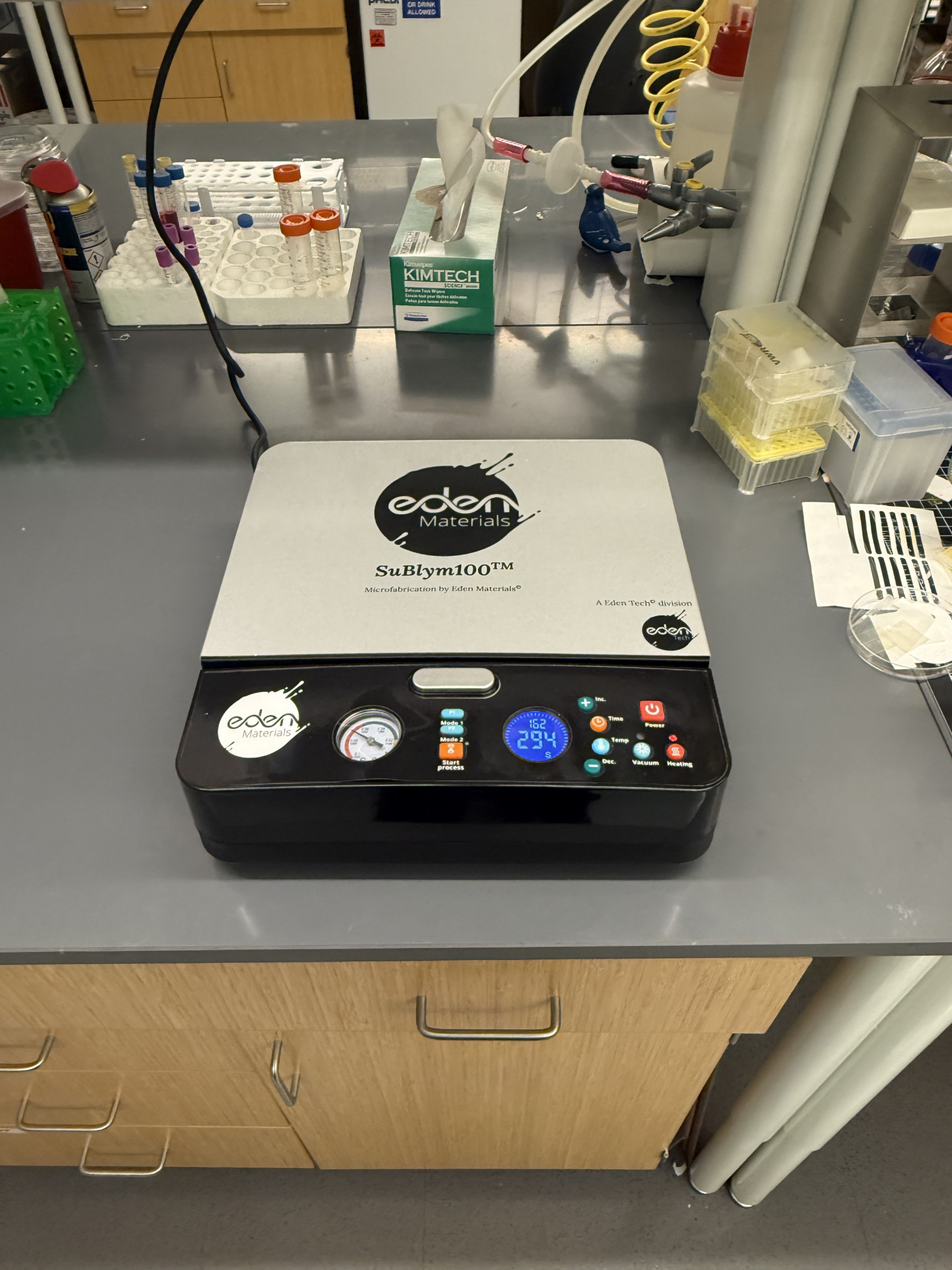
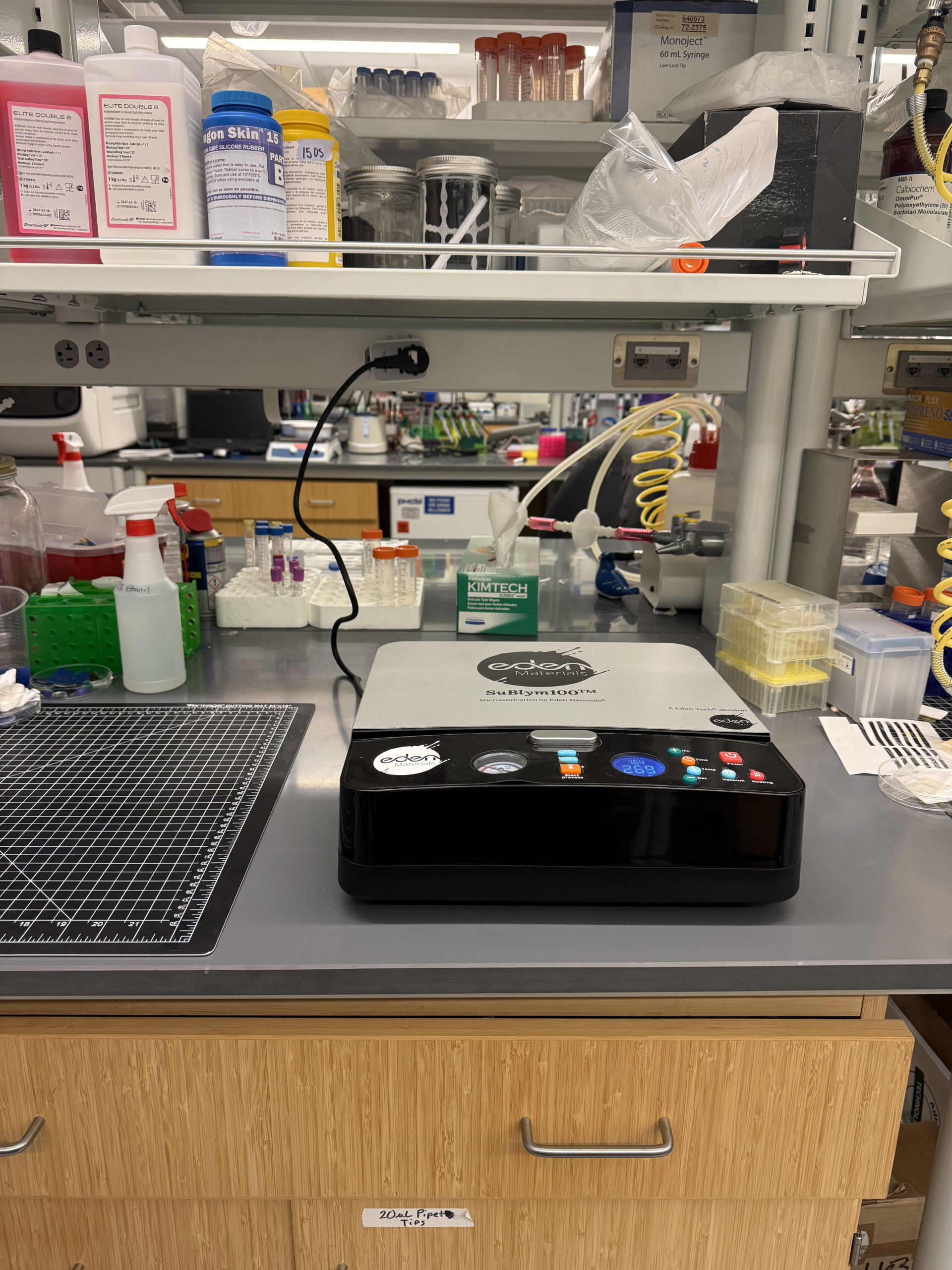
Lab space in a university research setting is always at a premium. The Sublym's compact and portable design meant it could fit easily on a bench without displacing existing equipment, a critical factor when traditional hot embossing systems can occupy an entire workstation.
Affordable for Academic Budgets
Grant-funded labs can't always justify the capital expenditure of industrial equipment. The Sublym offered a cost-effective entry point into thermal bonding, making professional-grade hot embossing accessible without a five-figure investment.
From Setup to First Bonded Device: Getting Started with the Sublym Hot Embossing Machine
One of the most common barriers to adopting new lab equipment is the learning curve. Complex systems can sit unused for weeks while researchers find time to train on them. Alessandra's experience with the Sublym was the opposite.
It was very easy to get started with the Sublym. The user manual walked me through the general process very quickly. From there, it was a matter of trial and error to tune the machine's settings for the materials and geometries I was working with.
— Alessandra LunaNo specialized training sessions were required. No technician visits. The Sublym's user manual was sufficient to get Alessandra running her first bonding cycles within a short time of unboxing. The remaining optimization — dialing in temperature, pressure, and cycle duration for her specific acrylic layups — followed the intuitive trial-and-error process familiar to any experienced microfluidics researcher.
Results: Speed, Quality, and New Capabilities
75% Reduction in Fabrication Time
The productivity gains were immediate and substantial. Alessandra's old workflow — laser-cutting adhesive layers and then hand-assembling each device, consumed roughly 33 minutes per device (30 min cutting + 3 min assembly). With the Sublym, a complete molding cycle takes just 7.5 minutes. Even more impactful, the Sublym can process 4 to 5 devices simultaneously in a single batch, meaning effective per-device time drops to under 2 minutes.
When factoring in batch processing, the Sublym effectively delivers a 93% reduction in per-device fabrication time compared to the previous manual adhesive workflow (from ~33 min/device to ~1.5–1.9 min/device).
Dramatically Improved Bond Quality & Durability
The shift from adhesive to thermal bonding didn't just save time, it fundamentally improved the devices themselves. Where adhesive seals would fail within days, thermally bonded acrylic layers produce a permanent, hermetic seal. For an implantable intracranial pressure sensor, this improvement in long-term stability is not merely convenient, it's a prerequisite for clinical viability.
The seal between my microfluidic layers is much more consistent and durable. Our double-sided adhesives would peel off after several days, but thermally bonding our layers together is more permanent.
— Alessandra LunaNew Capability: Vacuum-Assisted Bonding
Beyond speed and durability, the Sublym unlocked a capability Alessandra didn't have access to before, vacuum-assisted bonding. The integrated vacuum feature evacuates air from between layers during the embossing cycle, ensuring zero trapped air bubbles. For microfluidic devices where trapped air can obstruct channels or compromise sensor accuracy, this feature alone can be the difference between a working prototype and a failed one.
Streamlined Prototyping Workflow
An often-overlooked benefit of the Sublym is how it simplifies the overall prototyping pipeline. By eliminating the laser-cutting step entirely, Alessandra reduced her dependency on ancillary equipment and cut down the number of discrete process steps. The result is a leaner, faster workflow with fewer failure points.
The Sublym has greatly improved my productivity. It has given me a lot of flexibility with prototyping and has cut down my need for additional processes like laser cutting.
— Alessandra LunaBefore vs. After: Side-by-Side Comparison
| Metric | Before (Adhesive) | After (Sublym) |
|---|---|---|
| Sealing method | Double-sided adhesive | Thermal bonding |
| Time per cycle | ~33 min/device | 7.5 min (4–5 devices) |
| Seal durability | Days (peels off) | Permanent bond |
| Air bubble risk | High (manual placement) | None (vacuum feature) |
| Batch processing | 1 device at a time | 4–5 devices per cycle |
| Ancillary equipment | Laser cutter required | Self-contained |
| Consistency | Variable (manual) | High (controlled process) |
Cost, Space & Return on Investment
For academic labs evaluating hot embossing solutions, two factors tend to dominate the conversation: cost and space. Traditional hot embossing systems, while capable, often require dedicated floor space and budget allocations in the tens of thousands of dollars. The Sublym hot embossing machine occupies a fundamentally different position in the market.
From a cost perspective, I think Sublym is very affordable. Traditional hot embossing equipment can be very large and several thousands of dollars. I think the Sublym is a good investment for anyone that needs a quick and effective embossing machine that does not occupy too much space.
— Alessandra LunaWhen you factor in the elimination of consumable adhesive materials, the removal of the laser-cutting step, and the time savings across hundreds of prototyping cycles, the total cost of ownership of the Sublym becomes remarkably compelling. Researchers gain access to industrial-quality thermal bonding at a fraction of the price and footprint.
The Verdict: Who Should Consider the Sublym?
I would definitely recommend the Sublym to colleagues. Especially anybody trying to create microfluidics with plastics. It is convenient, affordable, and easy to use.
— Alessandra LunaBased on this case study, the Sublym hot embossing machine is an ideal fit for research teams and labs that work with thermoplastic microfluidic devices (especially PMMA/acrylic), need reliable thermal bonding without the cost of industrial equipment, operate in space-constrained lab environments, or require fast turnaround for iterative prototyping.
Whether you're fabricating medical devices, organ-on-a-chip platforms, diagnostic cartridges, or microfluidic sensors, the Sublym hot embossing machine delivers professional-grade results at a price point and form factor designed for the realities of academic and startup labs.
Frequently Asked Questions About the Sublym Hot Embossing Machine
How long does a hot embossing cycle take with the Sublym?
Can the Sublym bond acrylic (PMMA) microfluidic layers?
Is the Sublym suitable for small labs with limited bench space?
How does the Sublym compare to traditional hot embossing equipment in terms of cost?
Does the Sublym require specialized training?
What types of microfluidic devices can the Sublym produce?
Ready to Transform Your Microfluidic Fabrication?
Join researchers at Emory University, Georgia Tech, and labs worldwide using the Sublym hot embossing machine.
Discover the Sublym →